Prayer & Worship · RUKN
Why Friday matters: Jumu‘ah, remembrance and a weekly return
Friday brings Muslims together for remembrance, the khutbah and congregational prayer. The Quran calls believers away from trade for the gathering, while prophetic reports describe the day’s distinction. Attendance rules and some recommended practices differ between legal traditions.
Quran 62:9–10 · Sahih Muslim 854b · Sahih al-Bukhari 920 · Sistani, Islamic Laws, ruling 719 · Dar al-Ifta, making up a missed Friday prayer · Sahih al-Bukhari 883 · Dar al-Ifta, the bath before Friday prayer · Sahih al-Bukhari 934 · Sahih Muslim 857a · Sahih Muslim 233c · Sahih Muslim 852b · Sunan Abi Dawud 1047 · Sahih Muslim 1144b · Quran 62:10
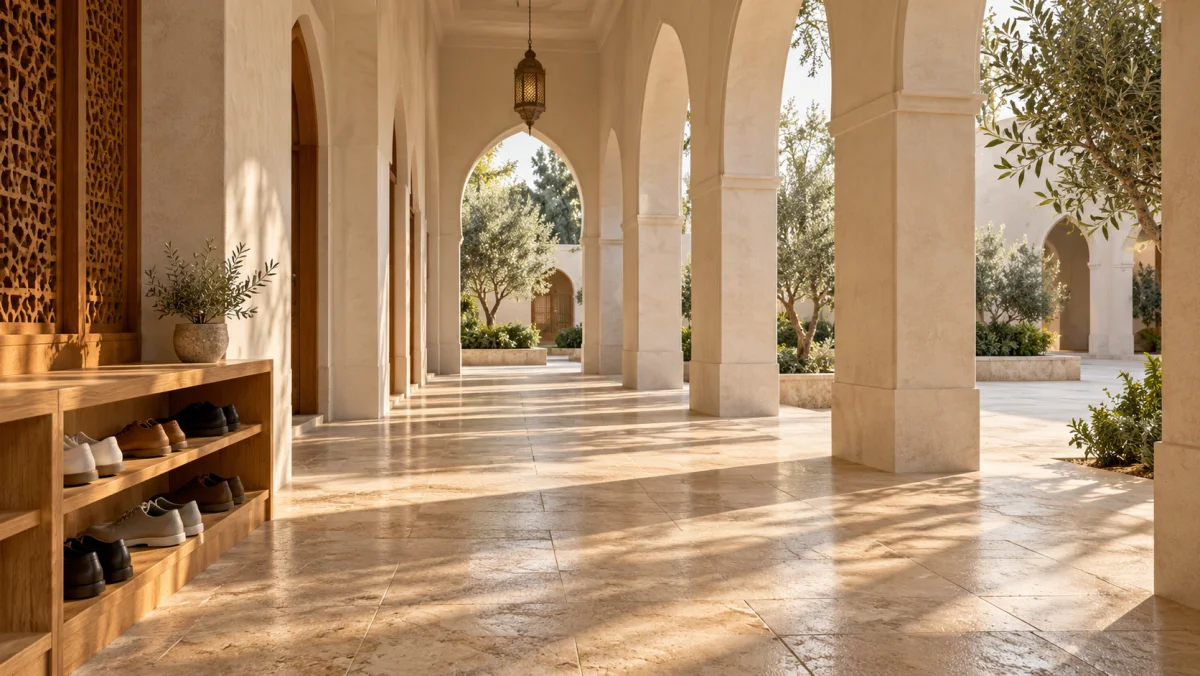
Friday gives the week a shared point of return: believers gather, listen and pray, then carry remembrance back into ordinary responsibilities. Its importance rests on the Quran’s call to leave trade for the Friday gathering and on prophetic teachings about the day. The details of attendance and recommended practices need care, because their legal interpretation is not identical across Muslim traditions. Quran 62:9–10; Sahih Muslim 854b.
Why does Friday matter in Islam?
Surah al-Jumu‘ah describes a deliberate interruption. When the call is made, believers are directed towards Allah’s remembrance and away from buying and selling. After prayer, they may disperse and seek His provision while continuing to remember Him. Worship and earning a living appear within the same passage; the gathering establishes a priority within daily life. Quran 62:9–10.
In a report preserved in Sahih Muslim, the Prophet Muhammad ﷺ describes Friday’s distinction and connects it with Adam’s creation and entry into Paradise. For a reader learning the tradition, this explains why Friday is treated as more than a convenient weekly meeting day. The narration is a statement about religious significance, not a method for predicting the date of the Last Hour. Sahih Muslim 854b.
The Quranic passage also makes an everyday demand: sometimes a transaction, a meeting or a stream of messages must wait. One practical way to honour that priority is to identify the actual congregation you will attend before Friday arrives. Its arrangements cannot be inferred from a generic midday notification.
What is Jumu‘ah prayer?
Jumu‘ah is the congregational Friday prayer with sermons before its two prayer units, or rak‘ahs. Ibn ‘Umar’s description of the Prophet ﷺ records the sermon being delivered standing, with a sitting between its two portions. These are parts of one gathering; they should not be confused with separate services advertised at different hours. Sahih al-Bukhari 920; Sistani, Islamic Laws, ruling 719.
The sermon, or khutbah, therefore belongs in an attendee’s plan. Arriving only for the expected prayer time overlooks a substantial part of the gathering. For timetable labels, adhan and iqamah, use our separate guide to Friday prayer times. That article addresses logistics; this one addresses the day’s meaning and preparation.
Who is required to attend?
In the Sunni account presented by Egypt’s Dar al-Ifta, Friday attendance is obligatory for adult Muslim men who meet its conditions, while women, children, people who are ill and travellers are among those exempt. A recognised excuse matters: the institution distinguishes unavoidable absence from neglect. Someone excused from attendance should seek the relevant guidance on their Dhuhr prayer rather than assume that all prayer has been waived. Dar al-Ifta, making up a missed Friday prayer.
There is also a significant difference between legal traditions. Ayatollah Sistani’s published Twelver Shia ruling describes Friday prayer as an optional obligation: where its conditions are fulfilled, a person may perform Jumu‘ah or Dhuhr, and a valid Jumu‘ah suffices in place of Dhuhr. This is his stated ruling; it should not be extended to every Shia authority without checking. Sistani, Islamic Laws, ruling 719.
An exemption from the congregation does not exclude a person from Friday’s remembrance and supplication. Nor does another person’s attendance establish that their circumstances match yours. For questions involving illness, access, caring responsibilities or work constraints, give a qualified scholar the actual facts rather than applying a general list to yourself. Quran 62:9–10; Sahih Muslim 852b.
Prepare for the people around you
A narration from Salman al-Farsi brings preparation and conduct together: bathing and cleanliness, going to the gathering without separating people already seated, and listening while the imam speaks. The sequence directs attention to how one person’s worship affects the people nearby. Sahih al-Bukhari 883.
The legal status of the Friday bath, or ghusl, has been discussed differently by scholars. Dar al-Ifta explicitly acknowledges disagreement and adopts the position that it is Sunnah for attendees, including people for whom attendance is not obligatory. Describe that as the institution’s chosen ruling rather than asserting that every scholar classifies it identically. Dar al-Ifta, the bath before Friday prayer.
In practical terms, leave time to prepare and arrive without rushing through other people’s space. Check an unfamiliar building’s entrance and accessibility arrangements beforehand. Put shoes and belongings where they will not obstruct others. These are useful ways to apply consideration; they are not a new list of religious conditions for a valid prayer.
Give the khutbah your attention
One striking narration warns against even telling a companion to be quiet while the imam delivers the sermon. Its force is easy to miss: a person can distract others while attempting to correct a distraction. Sahih al-Bukhari 934.
Settle practical arrangements before sitting down: silence ordinary notifications and agree where to meet afterwards. If you need help understanding the sermon or accessing the gathering, ask the mosque beforehand what support is available. Local arrangements differ, so an article cannot promise a particular language, interpretation service or facility.
Reports also connect attentive attendance with forgiveness. Read those encouraging teachings alongside the narration that makes avoidance of major sins a condition in its account of the expiation between Fridays. A weekly gathering should encourage repentance and better conduct, not be presented as automatic cancellation of every wrong. Sahih Muslim 857a; Sahih Muslim 233c.
Make room for dua and blessings upon the Prophet ﷺ
A report in Sahih Muslim describes a brief time on Friday when a Muslim, standing in prayer, asks Allah for good and receives it. Its wording encourages hope and supplication, or dua; it does not provide a civil-clock appointment that can be copied worldwide. Sahih Muslim 852b.
Keep your requests sincere and specific: forgiveness, guidance, help with a responsibility, or good for someone else. Those are examples for reflection, not a prescribed Friday formula or a promise of a particular outcome by a deadline.
Another report encourages abundant blessings upon the Prophet ﷺ on Friday. The cited Sunan Abi Dawud narration is graded sahih by al-Albani on the linked edition. The encouragement does not, in that narration, impose a single universal count that every Muslim must complete. Sunan Abi Dawud 1047.
Does Friday’s importance mean you should fast that day?
Not simply because it is Friday. A report in Sahih Muslim warns against singling Friday out for fasting, while making an exception for a person’s customary fast coinciding with it. This distinction matters when a monthly fasting habit happens to fall on Friday. Respect for the day and a rule about selecting it for fasting are different questions. Sahih Muslim 1144b.
If you are following a particular legal school or deciding how this applies to an obligatory or voluntary fast, check its guidance. A general Friday article should not turn one brief report into an answer for every fasting circumstance.
A Friday rhythm you can sustain
Before the day, confirm the mosque’s formal khutbah time and make room for preparation and travel. At the gathering, be considerate and listen. Elsewhere in the day, set aside a little attention for dua, remembrance and blessings upon the Prophet ﷺ. These planning suggestions can be adapted to your circumstances without inventing a fixed devotional programme.
Afterwards, the Quran’s instruction still applies: carry remembrance into the return to work and daily life. One useful question is what you will put into practice from what you heard. The answer might be a duty to fulfil or a wrong to repair. Friday’s recurring place in the week gives that reflection somewhere to return. Quran 62:10.